Can You Build Muscle With Light Weights? What Women Over 50 Need to Know
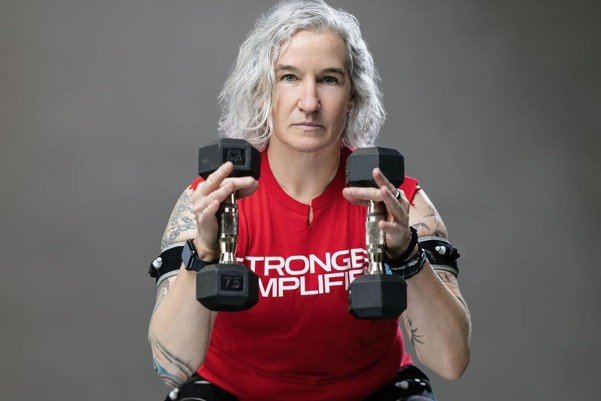
Why Your Muscles Care More About Stimulus Than Weight
For most of my career, I believed what nearly every strength coach believed. If you want to build muscle, you lift heavier.
Heavy lifting works, and if your body tolerates it well, it deserves a place in a well-rounded strength program. But it isn't the whole story.
Can you build muscle with light weights? Yes. Your muscles don't know the number printed on the dumbbell in your hand. They respond to the stimulus your workout creates.
That distinction completely changed how I think about strength training, particularly for women over 50 who know they need to maintain muscle but are also navigating menopause, joint pain, previous injuries, or simply a body that doesn't recover the way it did at 30.
After more than 30 years as a strength coach, I've stopped asking only, How much weight can you lift? I'm much more interested in a different question: What does your muscle need to experience in order to adapt?
This is where Blood Flow Restriction earns a closer look.
More weight is one way to create a challenge to your muscles. But it isn't the only way. With Blood Flow Restriction training, we're intentionally changing the environment inside the working muscle. That allows us to create significant muscular fatigue and recruit higher-threshold muscle fibers while using loads that would ordinarily feel quite light.
So when I talk about building muscle with light weights, I'm talking about finding another way to make your muscles work hard without requiring your joints to carry the same heavy load.
Why does this matter so much for women over 50?
Because the importance of strength training goes up at exactly the time many women find that their old way of training becomes harder to sustain.
That's the frustrating part. You know maintaining muscle matters. You may be hearing more than ever about lifting heavy during menopause. At the same time, your knees may be less enthusiastic about that advice. An old shoulder injury starts speaking up. Recovery can feel different.
We still need stimulus. We still need progression. What can change is the strategy we use to get there.
For someone whose body tolerates heavy resistance beautifully, heavier strength training may still be an excellent option. For someone who can't comfortably produce enough muscular stimulus with heavy loads anymore, we need another tool.
For me, that other tool was Blood Flow Restriction training.
Why did I rethink the way I had trained for decades?
Because my own body eventually stopped tolerating the strategy I had spent my career teaching.
I've been in the fitness industry for more than 30 years. I've coached elite athletes. I've owned a gym. I understand strength training as well as just about anyone.
And then I went through menopause earlier than I expected and had a difficult hip replacement. My right leg visibly atrophied after surgery. I knew what I was supposed to do: get stronger, progress the load, build the muscle back. Knowing what to do wasn't the problem. Having a body that could no longer tolerate heavier loads was. That's a humbling experience when you're a strength coach. Eventually I realized I needed to find another way.
That quest is what led me to Blood Flow Restriction training.
And the results surprised me. Within just four weeks of incorporating BFR, I had regained the muscle in my right leg that I had struggled to rebuild for years.
So naturally, I started sharing what I was learning. First with friends, then with clients. And they started seeing changes, too.
At that point, I wanted to know more. Were we simply seeing a handful of great individual outcomes, or was there something happening that we could actually measure?
Eventually, my team and I conducted a six-month real-world observational pilot study of women ages 39 to 68 participating in a structured Seli Strength BFR program.
The women trained with body weight, resistance bands, and relatively light (5-10lb) dumbbells for 20 minutes at a time, from home. At the end of six months, participants showed statistically significant improvements: loss of body fat, increase in strength and endurance, lower pain, and improved heart health. Waist and hip circumference were down an average of 1.4 and 1.1 inches, push-up capacity increased by 13 reps, wall-sit time climbed by more than a minute, and resting heart rate improved by nearly 4 bpm. One participant lost 4.25 inches from her waist and reported significant pain relief. And interestingly, the improvements were greater among the women over 50.[2]
Seeing measurable changes in a real-world group of women strengthened something I had already begun to understand through my own experience: We don't necessarily need heavier weights to create a meaningful training stimulus. And now I wanted to understand why.
How does Blood Flow Restriction training make light weights more challenging?
BFR changes the internal environment of the working muscle so a relatively light load can create a much larger training demand.
During Blood Flow Restriction training, specialized cuffs are placed high on the arms and/or legs and inflated to an appropriate pressure. The goal is to restrict venous outflow while still allowing arterial blood to enter the limb, not to completely stop blood flow.
A 2019 research-informed position stand led by Stephen Patterson and a large group of BFR researchers details the methodology, application, and safety considerations for using BFR with resistance and aerobic exercise.[3]
Here's the physiology in plain English:
Your Type I fibers rely heavily on oxygen to keep working. During BFR, the working muscle experiences reduced oxygen availability. Those lower-threshold fibers fatigue more quickly, increasing the need to recruit higher-threshold motor units even though the external weight is relatively light.
That's the part that changed everything for me. We can change the muscular stimulus without simply adding more weight.
In my webinar Discover BFR: The Biggest Fitness Breakthrough You Haven't Tried, I describe it as bringing the Type II fibers into the game at loads that normally wouldn't get them involved.[7] For a woman whose muscles need more challenge but whose joints don't need more mechanical load, that creates an entirely different option.
What does the research say about BFR and muscle growth after 50?
The evidence suggests low-load BFR can improve muscle size and strength in older adults, although heavier resistance can still have an advantage for maximal strength.
A 2019 systematic review and meta-analysis by Christoph Centner and colleagues examined BFR in older individuals. Compared with high-load resistance training, low-load BFR produced similar muscle hypertrophy.[4]
Later reviews reach the same conclusion. Baker and colleagues, and separately Labata-Lezaun's team, found that low-load BFR builds muscle size and strength, though heavy resistance still wins on maximal strength.[5,6]
I actually like that the evidence is nuanced. Because I'm not interested in telling you BFR magically makes heavy lifting obsolete. It doesn't. I'm interested in giving people more ways to stay strong.
Does heavy lifting still matter after 50?
Absolutely. I am not anti-heavy lifting.
If your joints feel good, you recover well, you enjoy lifting heavy, and it's appropriate for your body, there are real reasons to keep doing it. Heavier loads are particularly useful for maximizing high-load strength.[1]
The right call depends on what your body tolerates and what actually keeps you training consistently. For some, that's heavier loads. For others, it's BFR. Often, it's both.
Frequently Asked Questions
Is BFR the same as simply lifting light weights?
No. BFR changes the physiological environment of the working muscle by using specialized cuffs to restrict venous blood flow while maintaining arterial inflow. This allows relatively light resistance to create a different training stimulus than the same light exercise performed without BFR.[3]
Is BFR better than heavy lifting?
Not across every outcome. Research in older adults suggests low-load BFR can produce muscle growth comparable to high-load resistance training, while heavy resistance may produce greater maximal strength gains.[4,5,6] The best choice depends on your goals, health, joint tolerance, and ability to train consistently.
Is Blood Flow Restriction training safe?
BFR has an established body of research and published guidance around methodology and safety, but correct equipment, pressure, screening, and application matter. People with medical conditions or concerns should talk with an appropriate healthcare professional before beginning BFR training.[3]
The Bottom Line
Yes, you can build muscle with light weights.
Heavy lifting remains an effective way to build strength and muscle, but it isn't the only way to create a meaningful training stimulus. For women over 50 whose joints, recovery, or physical limitations make heavy training difficult, that distinction matters. BFR gives us another evidence-based way to make lighter loads count.
Not an easier way to exercise. Another way to train hard enough to create change.
Ready to see how joint-friendly strength training can feel?
See how Seli Strength's BFR-based programs build muscle with light weights.
References
[1] Schoenfeld BJ, Grgic J, Ogborn D, Krieger JW. Strength and Hypertrophy Adaptations Between Low- vs. High-Load Resistance Training: A Systematic Review and Meta-analysis. Journal of Strength and Conditioning Research. 2017;31(12):3508–3523. doi:10.1519/JSC.0000000000002200. https://pubmed.ncbi.nlm.nih.gov/28834797/
[2] Seli Strength, LLC. Observational Outcomes of Blood Flow Restriction Training in Female Exercisers: A Real-World Pilot Study. https://www.selistrength.com/bfr-training-results-women-over-50
[3] Patterson SD, Hughes L, Warmington S, et al. Blood Flow Restriction Exercise: Considerations of Methodology, Application, and Safety. Frontiers in Physiology. 2019;10:533. doi:10.3389/fphys.2019.00533. https://pubmed.ncbi.nlm.nih.gov/31156448/
[4] Centner C, Wiegel P, Gollhofer A, König D. Effects of Blood Flow Restriction Training on Muscular Strength and Hypertrophy in Older Individuals: A Systematic Review and Meta-Analysis. Sports Medicine. 2019;49:95–108. doi:10.1007/s40279-018-0994-1. https://pubmed.ncbi.nlm.nih.gov/30306467/
[5] Baker BS, Stannard MS, Duren DL, Cook JL, Stannard JP. Does Blood Flow Restriction Therapy in Patients Older Than Age 50 Result in Muscle Hypertrophy, Increased Strength, or Greater Physical Function? A Systematic Review. Clinical Orthopaedics and Related Research. 2020;478(3):593–606. doi:10.1097/CORR.0000000000001090. https://pubmed.ncbi.nlm.nih.gov/31860546/
[6] Labata-Lezaun N, Llurda-Almuzara L, González-Rueda V, et al. Effectiveness of Blood Flow Restriction Training on Muscle Strength and Physical Performance in Older Adults: A Systematic Review and Meta-analysis. Archives of Physical Medicine and Rehabilitation. 2022;103(9):1848–1857. doi:10.1016/j.apmr.2021.12.015. https://pubmed.ncbi.nlm.nih.gov/35026149/
[7] Selman A (Coach Seli). Discover BFR: The Biggest Fitness Breakthrough You Haven't Tried [webinar]. Seli Strength. https://www.youtube.com/watch?v=gjMq4tSjGBI