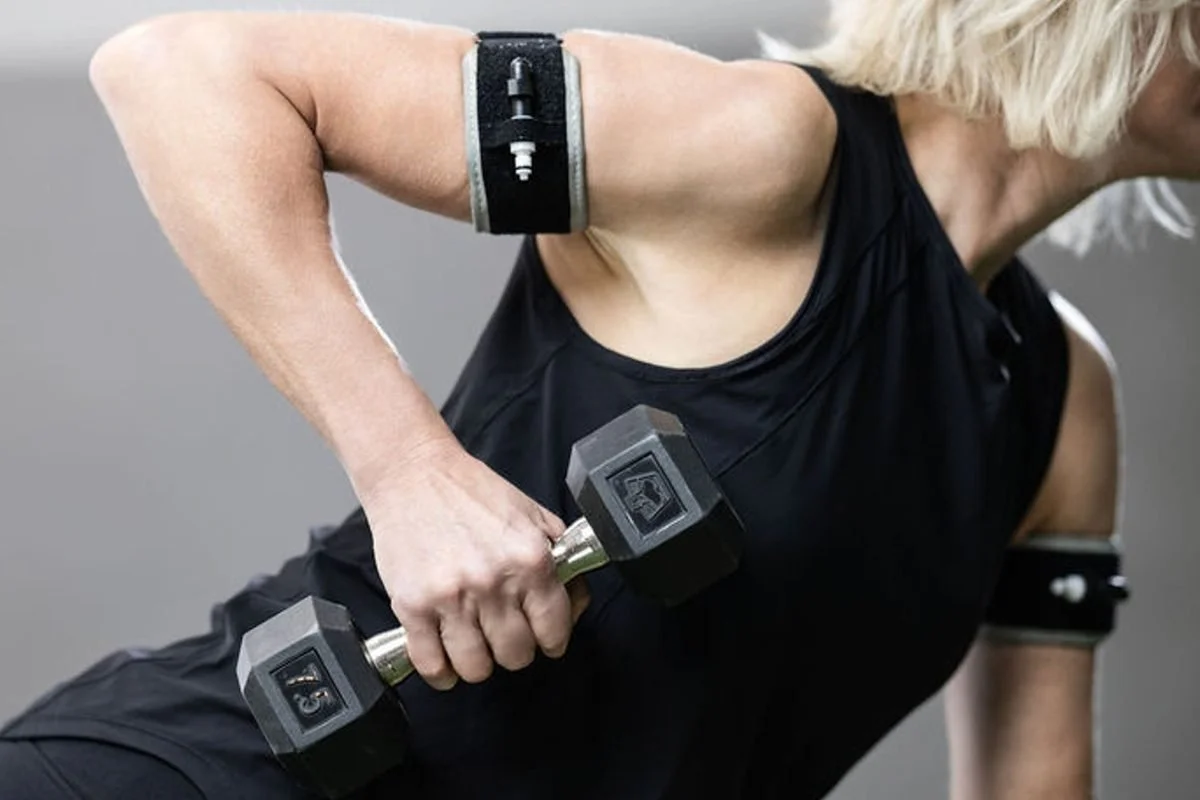
No, you don’t have to lift heavy to get most of the benefits of heavy lifting. Light weights work when you pair them with blood flow restriction (BFR) training. Heavy lifting works too. It’s just not the only way to build muscle, and for many women in midlife it isn’t the most sustainable one.
I went through the research on BFR and heavy lifting across 12 benefit areas, and BFR matches or beats heavy lifting in 10 of them. Heavy lifting keeps the edge on maximum strength and on subcutaneous fat.
Here's the scorecard. Each row is explained below, with the research behind it.
BFR vs Heavy Lifting Scorecard Across 12 Benefit Areas
| Category | Verdict |
|---|---|
| Hypertrophy (muscle growth) | Tie (BFR edge) |
| Subcutaneous fat | Tie (heavy lifting edge) |
| Visceral fat | BFR wins |
| Human growth hormone (HGH) | BFR wins |
| Joint stress | BFR wins |
| Recovery time and soreness | BFR wins |
| Capillary density | BFR wins |
| Cardiovascular stress | BFR wins |
| Long-term sustainability | BFR wins |
| Brain health | Tie (different pathways) |
| Bone density | Tie |
| Maximum strength | Heavy lifting wins |
Can you build muscle with light weights?
Yes. Light weights with BFR build about as much muscle as heavy lifting.[1,2] Two reviews that pooled results from many studies, a 2018 systematic review and meta-analysis and a 2019 meta-analysis of adults over 50, found similar muscle growth with both approaches.
I think BFR may have a slight edge, and here's my reasoning. The bands hold blood in the muscle, which raises lactate and recruits more fast-twitch fibers, the ones built for strong, quick effort. In plain terms, light weights with BFR ask your muscle to work as if the load were much heavier.
Which is better for body fat, BFR or heavy lifting?
Your body stores fat in two places, and BFR and heavy lifting affect them differently. Subcutaneous fat is the layer under the skin you can pinch. Visceral fat sits deep in your abdomen, around your organs, where you can't pinch it.
For the fat you can pinch, heavy lifting has the edge. In a 12-week study of adults with type 2 diabetes, subcutaneous fat dropped significantly only in the heavy lifting group, not the BFR group.[3] The drop was about 5% with heavy lifting and 3% with BFR. My read: the sustained heavy load does more for this layer than BFR's chemical stress signals do, though exercise choice matters a lot. A 2025 meta-analysis of fat loss found that aerobic and combined training reduced fat mass more than strength training alone,[4] which is one reason our program includes weekly cardio.
Visceral fat is the kind linked to inflammation and organ risk, and BFR looks better here. In the same 12-week study, visceral fat fell 13% in the BFR group and 3% in the heavy lifting group.[3] A 2026 trial in adults with obesity suggests why: BFR creates more metabolic stress and greater human growth hormone (HGH) release, which helps your body pull visceral fat out of storage so it can be burned for energy.[5]
Does BFR boost human growth hormone (HGH) more than heavy lifting?
Yes. BFR produces meaningfully more HGH per session than heavy lifting, which supports muscle building and recovery. The reason is lactate. The bands keep more blood in your working muscle, so lactate builds up fast, and your body reads that buildup as a signal to release HGH. The bigger the buildup, the bigger the signal. For a sense of scale, one 2000 study measured growth hormone in the blood at roughly 290 times its resting level after a low-intensity workout with restricted blood flow.[6]
Is BFR easier on your joints and recovery than heavy lifting?
Yes, mostly because the loads are lighter. A 2021 review of BFR training put loads at about 20 to 30 percent of your one-rep max (the heaviest weight you could lift once), compared with 70 to 85 percent for heavy lifting.[7] Lighter loads put less mechanical stress on your joints for the same muscle stimulus, which is why a 2017 review of BFR in rehabilitation describes BFR with light weights as useful: it doesn't require the high joint forces of heavy lifting.[8]
Lower loads also mean less muscle damage. A 2019 review of BFR safety and methodology notes that heavy lifting can damage muscle, especially in people new to it, and that BFR with light weights doesn't appear to cause the same damage.[9] Less damage means less next-day soreness. The 2021 review explains that this shortens recovery from a single session and may allow more frequent training, so you're ready to train again sooner.[7] You get the muscle stimulus without the wear and tear.
That matters because the best program is the one you can keep doing. I think shorter, lower-stress workouts with faster recovery are easier to sustain year after year, which is why sustainability made the scorecard.
How do BFR and heavy lifting affect your blood vessels and blood pressure?
BFR comes out ahead for your capillaries, your blood pressure, and your arteries.
Capillaries are the tiniest blood vessels, and they deliver oxygen and nutrients to your tissues. A 2022 meta-analysis found that BFR exercise raised angiogenesis markers, the chemical signals that tell your body to grow new blood vessels, more than the same exercise without BFR.[10] When those signals turn into more capillaries, oxygen and nutrients reach your muscle, brain and bone more easily.
Heavy sets can push blood pressure far higher than BFR does. For reference, a normal resting reading is under 120/80. A 1985 study of heavy resistance exercise recorded peaks up to 480/350 mmHg during heavy sets taken to failure.[11] In a 2005 study of low-intensity BFR exercise, pressure measured about 182/105 mmHg, which is within the normal range for exercise.[12]
Your arteries will fare better with BFR too. Heavy lifting has been linked to stiffer arteries, meaning arteries that lose some of their stretch. A 2015 study of older adults found that BFR with light weights built muscle size and strength without that stiffening.[13] A 2021 review adds that BFR puts about the same or less strain on your heart and blood pressure as heavy lifting, even in people with coronary artery disease (narrowed arteries feeding the heart).[7]
Which is better for brain health?
It's a tie. Heavy lifting and BFR training both show promise for brain health, and they seem to help in different ways. A 2025 narrative review of older adults suggests that resistance training like heavy lifting may help preserve brain structure and support memory and thinking.[14] BFR may add a different benefit through brain-derived neurotrophic factor (BDNF), a protein I think of as fertilizer for the brain because it helps keep connections between brain cells healthy. A 2025 systematic review linked BFR exercise to short-term increases in BDNF, potentially driven by the lactate produced during training, though the research is still emerging.[15] Put simply, BFR may help your brain keep adapting and keep its connections healthy.
Does BFR build bone like heavy lifting?
Yes, at least for bone mineral density, a measure of how dense and strong your bones are. A 2025 meta-analysis found no significant difference in bone density gains between BFR and heavy resistance training in older adults.[16] The same review found that BFR raised bone density and the hormones that support bone, including HGH and IGF-1 (a growth signal that works alongside HGH), compared with light training without BFR.
The routes differ. Heavy weights load the skeleton directly, while BFR appears to work through hormones and changes in blood flow and pressure inside the tissue, though that mechanism is still preliminary.
Where does heavy lifting still win?
Maximum strength. Two meta-analyses of adults over 50, the 2019 one above and a 2022 meta-analysis, both found larger maximal strength gains with heavy lifting than with BFR.[2,17]
The gap isn't about your muscle. BFR builds comparable muscle, so what heavy lifting adds is practice for your nervous system: coordinating everything at once and bracing against a heavy load. BFR doesn't replicate that. I'd also argue that raw max strength isn't what drives long-term health. Functional strength is. It helps you get up off the floor, stay steady on your feet, and put your suitcase in the overhead bin.
We still wanted to close the gap, so our program includes short all-out isometric exercises: maximal-effort holds against an immovable object. They train the same nervous system drive that heavy lifting requires, without the joint stress. It's the one piece BFR with light weights doesn't naturally cover, so we built it in.
What does this mean for how you train?
If heavy lifting works for your joints and your schedule, keep it. I'm not asking anyone to pick a side. I'm friends with heavy lifting. I lift heavy about twice a month because I enjoy it, and my weights are higher now than when I lifted heavy regularly, and I credit BFR for making me stronger between heavy sessions. If heavy lifting doesn't work for you, the scorecard suggests you're giving up less than the "lift heavy or don't bother" message we've all been hearing would have you believe.
What I care about is offering a program where nobody has to lift heavy if they don't want to and can still get most of the same benefits. Our BFR workout program is built around that idea: 20-minute strength workouts, 3 times a week, plus weekly cardio and mobility sessions, using light weights, exercise tubing, and BFR bands. It's live and on demand, from home.
So does it work for real people, not just in research papers? We wanted to know, so we followed a group of women through our program. In our six-month observational pilot study, of the 25 women ages 39 to 68 who enrolled, the 15 who finished improved waist and hip circumference, push-up performance, wall-sit endurance, and resting heart rate, with the greatest improvements among women over 50. It was observational and self-reported, and it had no control group, so I treat it as encouraging, not conclusive. Our results page summarizes the findings.
Frequently Asked Questions
-
No. Heavy lifting isn’t the only way to build muscle. If you don’t enjoy it, BFR with light weights is worth a look, since it builds about as much muscle as heavy lifting.[1,2] If you can handle heavy lifting, just not all the time, you could mix a few heavy sessions into a BFR program. And if you like it and your body tolerates it, keep doing it.
-
Yes, the research supports it. A 2019 meta-analysis of older adults found that BFR with light weights builds muscle comparable to heavy lifting.[2] In our own program’s six-month observational pilot study of women ages 39 to 68, the biggest improvements were among women over 50, though a pilot without a control group can't prove BFR caused them.
-
The 2021 review of BFR training describes loads of about 20 to 30 percent of your one-rep max (the most you could lift once), compared with 70 to 85 percent for heavy lifting.[7] In practice that means light dumbbells and exercise tubing. Many of our members start with 5, 8, 10, or 15 pound dumbbells. The bands keep blood in the working muscle longer, which is why a light load can stimulate like a heavier one.
-
BFR may be an option, but ask your clinician first. A 2017 review of BFR in rehabilitation describes it as a possible alternative for people who can't tolerate the stress that heavy lifting puts on the body.[8] Your diagnosis and stage of recovery decide whether BFR is a fit right now.
What's the bottom line?
BFR matches or beats heavy lifting in 10 of 12 benefit areas, including muscle growth, bone mineral density, visceral fat, and recovery. Heavy lifting keeps the edge in maximum strength and subcutaneous fat. If heavy lifting hurts or doesn't fit your life, you can build muscle with light weights and BFR and give up less than you'd expect. If you love heavy lifting, nothing here says to stop.
Curious what a BFR workout looks like? Try a free sample workout.
References
Numbers in brackets match the studies below. Each title links to the paper.
1. Lixandrão ME, et al. 2018. Magnitude of muscle strength and mass adaptations between high-load resistance training versus low-load resistance training associated with blood-flow restriction: a systematic review and meta-analysis. Sports Med. Systematic review and meta-analysis.
2. Centner C, et al. 2019. Effects of blood flow restriction training on muscular strength and hypertrophy in older individuals: a systematic review and meta-analysis. Sports Med. Systematic review and meta-analysis.
3. Trinks N, et al. 2026. Blood-flow restriction resistance training improves skeletal muscle mitochondrial capacity and cardiovascular risk factors in type 2 diabetes. Cell Metab. Intervention study, n=20, type 2 diabetes.
4. Lafontant K, et al. 2025. Comparison of concurrent, resistance, or aerobic training on body fat loss: a systematic review and meta-analysis. J Int Soc Sports Nutr. Systematic review and meta-analysis.
5. Li S, et al. 2026. The effect of blood flow restriction training on abdominal visceral fat and plasma N-lactoylphenylalanine among adults with obesity. BMC Endocr Disord. Trial in adults with obesity.
6. Takarada Y, et al. 2000. Rapid increase in plasma growth hormone after low-intensity resistance exercise with vascular occlusion. J Appl Physiol. Experimental study.
7. Freitas EDS, et al. 2021. The evolution of blood flow restricted exercise. Front Physiol. Review.
8. Hughes L, et al. 2017. Blood flow restriction training in clinical musculoskeletal rehabilitation: a systematic review and meta-analysis. Br J Sports Med. Systematic review and meta-analysis.
9. Patterson SD, et al. 2019. Blood flow restriction exercise: considerations of methodology, application, and safety. Front Physiol. Review.
10. Li S, et al. 2022. The effect of blood flow restriction exercise on angiogenesis-related factors in skeletal muscle among healthy adults: a systematic review and meta-analysis. Front Physiol. Systematic review and meta-analysis.
11. MacDougall JD, et al. 1985. Arterial blood pressure response to heavy resistance exercise. J Appl Physiol. Experimental study.
12. Takano H, et al. 2005. Hemodynamic and hormonal responses to a short-term low-intensity resistance exercise with the reduction of muscle blood flow. Eur J Appl Physiol. Experimental study.
13. Yasuda T, et al. 2015. Effects of low-load, elastic band resistance training combined with blood flow restriction on muscle size and arterial stiffness in older adults. J Gerontol A Biol Sci Med Sci. Training study in older adults.
14. Jiang W, et al. 2025. Effects of resistance exercise on cognitive function, neurotrophic factors, brain structure, and brain function in older adults: a narrative review. J Alzheimers Dis. Narrative review.
15. Landers JB, et al. 2025. The effects of blood flow restriction exercise on muscle-brain crosstalk: a systematic review. Muscles. Systematic review.
16. Liu Y, et al. 2025. Systematic review and meta-analysis of the effects of BFR training on bone health in older adults. Sci Rep. Systematic review and meta-analysis.
17. Labata-Lezaun N, et al. 2022. Effectiveness of blood flow restriction training on muscle strength and physical performance in older adults: a systematic review and meta-analysis. Arch Phys Med Rehabil. Systematic review and meta-analysis.